 Click inside the frame to go to the "RESEARCH OUTLINE Page".
Click the image to view detailed information.
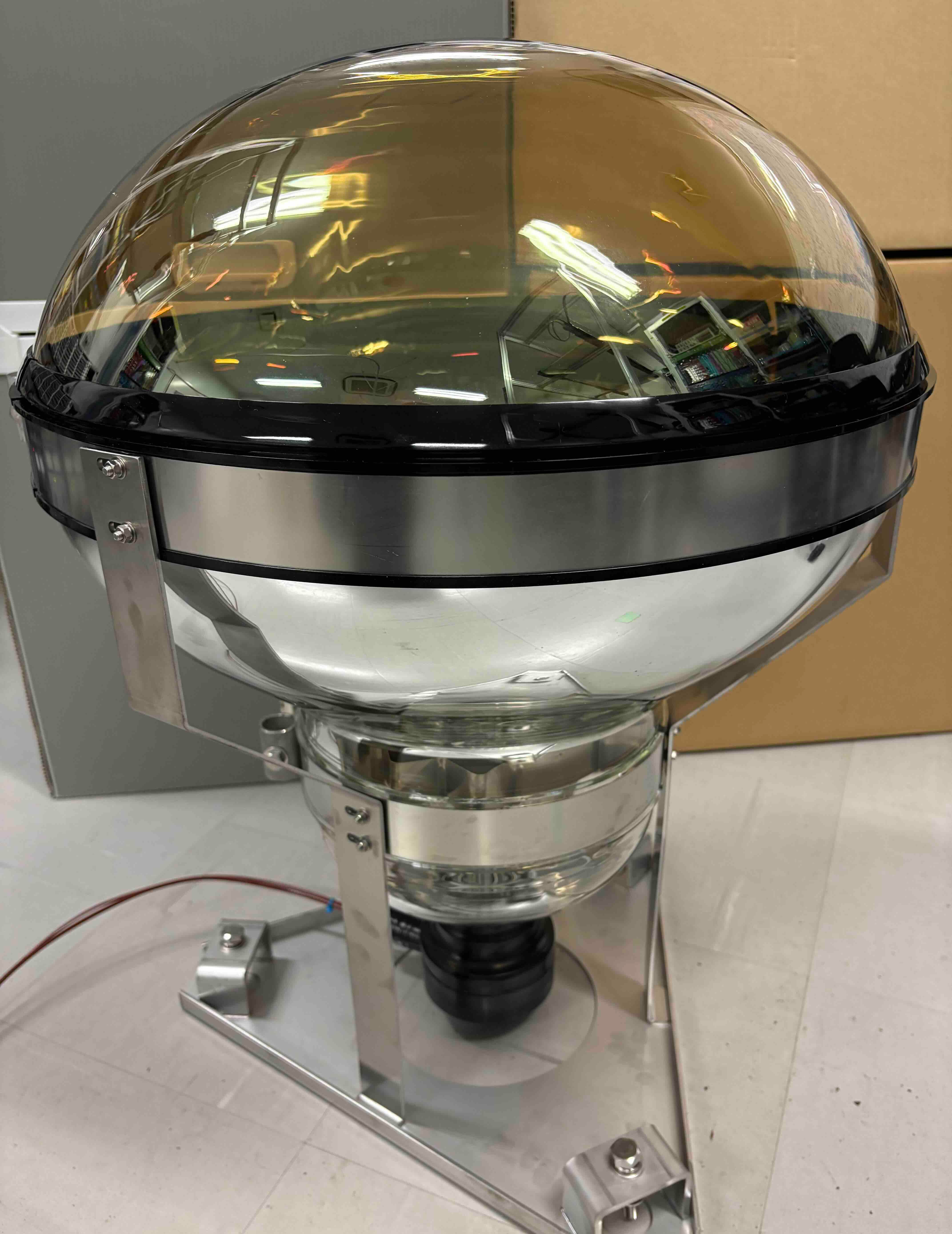
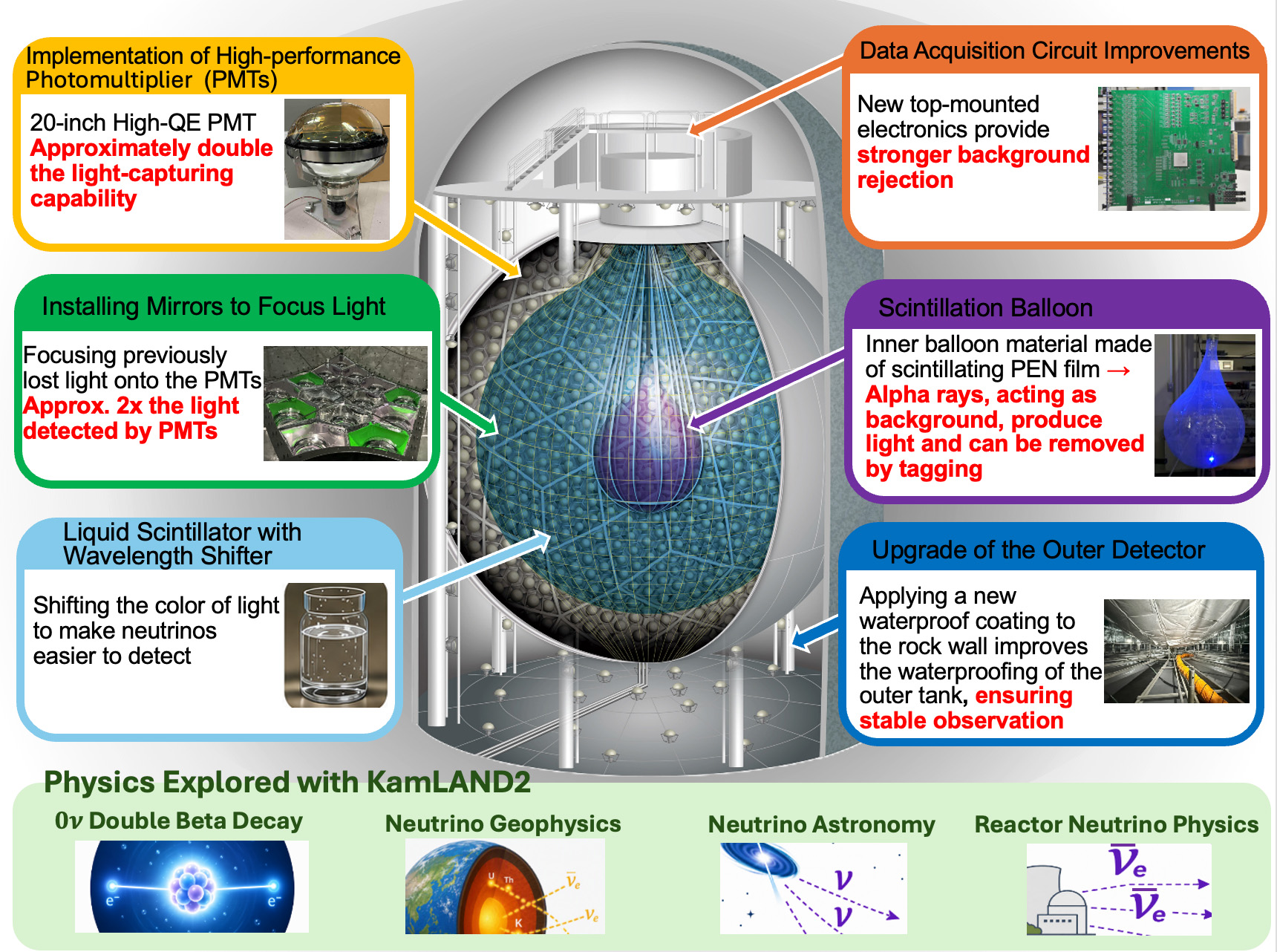
When double beta decay or a neutrino reaction occurs in the liquid scintillator inside the spherical KamLAND tank, faint light is emitted. In KamLAND2, newly introducing high-quantum-efficiency light sensors (PMTs) with a diameter of 50 cm and enhanced light detection performance enables the measurement of these phenomena with higher sensitivity.
Compared to previous optical sensors, the quantum efficiency (conversion efficiency from light to electrons) has significantly improved. Furthermore, improvements to the signal amplification mechanism have enhanced the timing precision of light detection and expanded the effective photocathode area. By replacing all approximately 1,900 optical sensors uniformly lining the inner surface of the spherical tank with high-quantum-efficiency sensors, the light collection amount is expected to increase by approximately 1.9 times.
To distinguish neutrinoless double beta decay—the search target of the KamLAND-Zen experiment—from other background noise events, it is known that increasing the detector's light collection capability is highly effective.
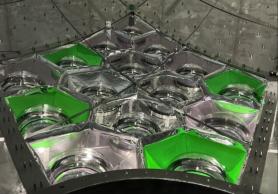
Therefore, the KamLAND2-Zen experiment installs light-collecting mirrors shaped like parabolic dishes on the PMTs.
The light-collecting mirrors are custom-made from aluminum-vapor-deposited PET resin, and their shape has been optimized using computer simulations to collect as much light as possible.
Furthermore, reflective sheets are attached to the edges of the light-collecting mirrors to capture even more light, doubling the amount of light that each PMT can detect.

In the double beta decay experiment at KamLAND2 (KamLAND2-Zen), we plan to enhance the performance of the liquid scintillator by adding a new wavelength shifter.
Liquid scintillators have the property of emitting light when reacting with radiation. This light is called scintillation light, which is detected by photomultiplier tubes (PMTs). In KamLAND2-Zen, we improve background discrimination by using a scintillating film (PEN) for the inner balloon, but this PEN absorbs light from the conventional liquid scintillator. Therefore, for background reduction using PEN, we need scintillation light that PEN does not absorb.
We aim to solve this problem by adding a chemical compound called a wavelength shifter, which slightly shifts the wavelength of light with high efficiency.
Although there are numerous wavelength shifters, we selected a chemical compound with properties suitable for the KamLAND experiment. In the selection process, a comprehensive evaluation was made based on criteria such as high efficiency in optical wavelength conversion, fast conversion speed, and appropriate converted wavelength. As a result, we plan to use a wavelength shifter called bis-MSB. Currently, we are conducting research and development to remove naturally occurring radioactive impurities, such as uranium and thorium, contained in this bis-MSB. Neutrinos, the measurement target of KamLAND, interact so rarely that they are often referred to as "ghost particles." It is necessary to reduce naturally occurring radioactive impurities to the ultimate limit. Therefore, in collaboration with the University of Tsukuba, we worked on upgrading detector performance to allow for ultra-sensitive measurements of uranium and thorium. We are conducting research and development so that these efforts will bear fruit, allowing us to observe neutrinos with the world's highest sensitivity.
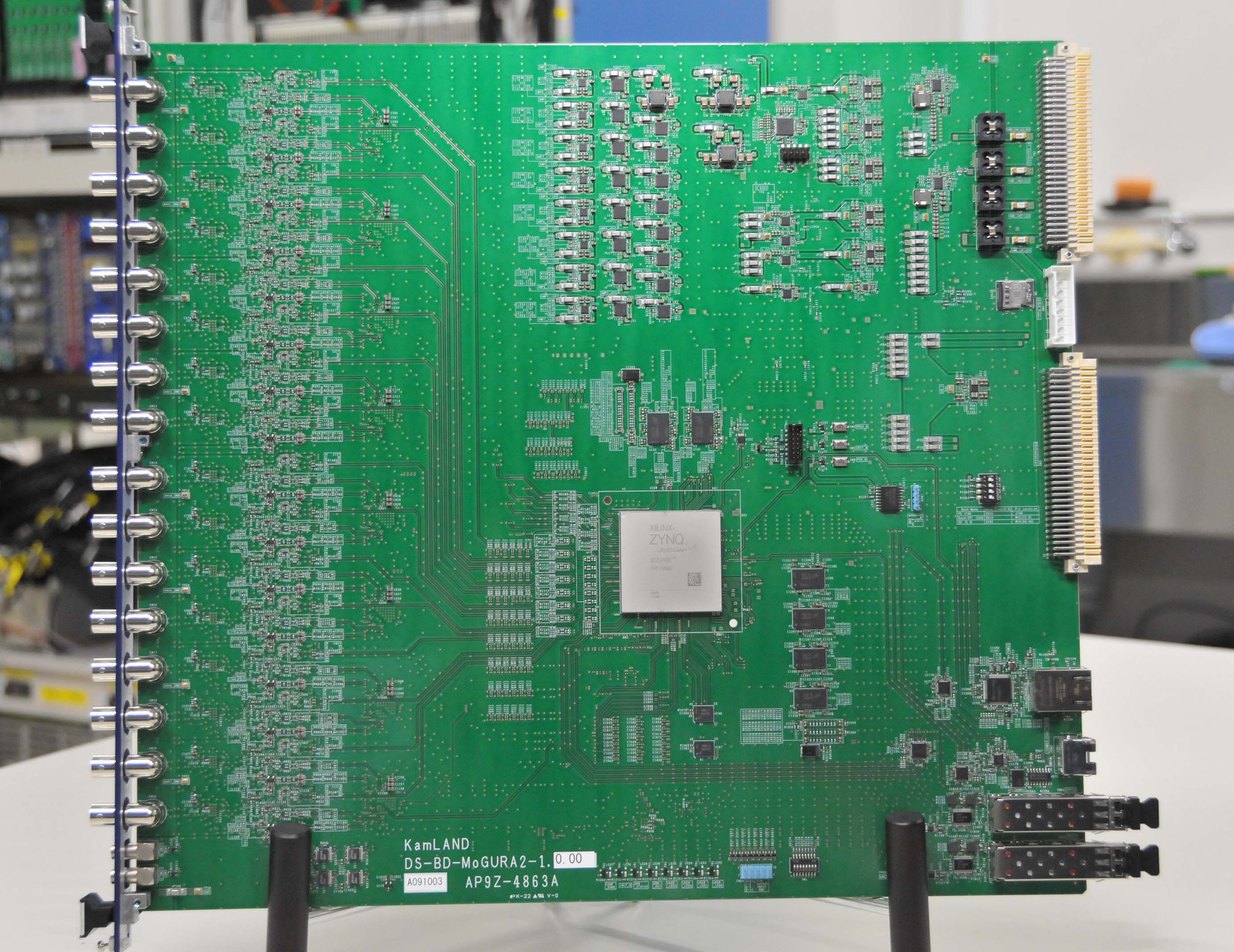
Signals from the photomultiplier tube (PMT) are output as electrical pulses. To analyze these signals on a computer, they must be converted into digital data that the computer can process. The electronic circuit system serves as the bridge for this process.
We have developed an electronic circuit system that features signal processing functionality optimized for the signal amplitude of the photomultiplier tubes used in KamLAND2, capable of high-speed conversion at a rate of 1 billion times per second. This system reduces the dead time during conversion, which was an issue in KamLAND, and improves data transfer speeds.
In KamLAND2, by utilizing this electronic circuit system, we aim to more comprehensively detect particles associated with cosmic-ray muon events that were previously difficult to capture, thereby enhancing measurement sensitivity.
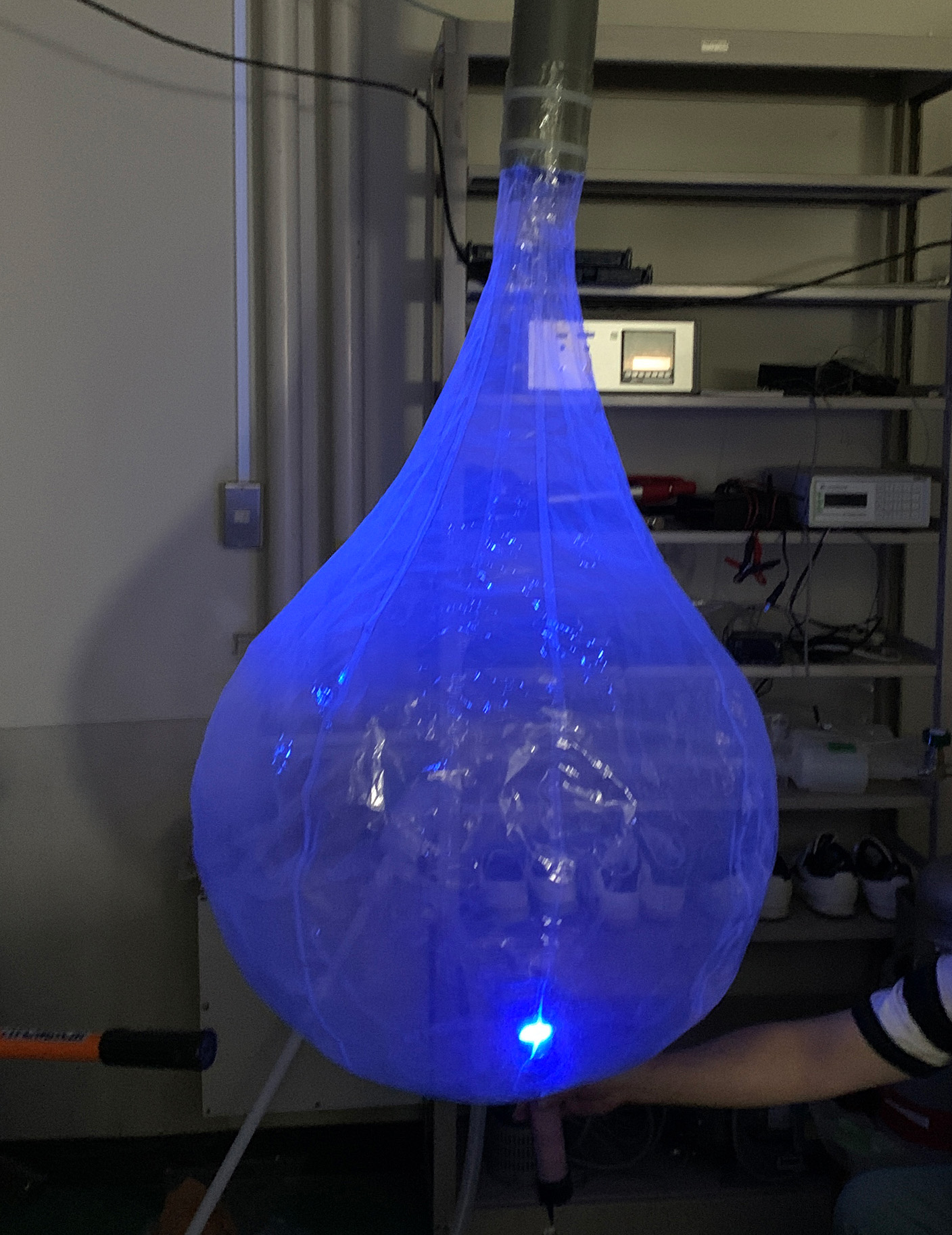
In the KamLAND-Zen experiment, a mini-balloon made of 25-micrometer-thick nylon is filled with xenon-loaded liquid scintillator, with the aim of observing signals of neutrinoless double-beta decay occurring within it. The material of this nylon mini-balloon contains an extremely trace amount of radioactive impurities from the uranium series—less than 3 trillionths of a gram per gram (3 × 10-12 g/g). A radioactive isotope present in this uranium series, bismuth-214 (214Bi), creates background noise signals in the search for double-beta decay.
While the noise signals from bismuth-214 can be identified and rejected by detecting the alpha decay signal of polonium-214 that occurs shortly thereafter (164μs ), alpha decays of polonium-214 inside the nylon film cannot be observed.
To remove this noise signal, the KamLAND2-Zen experiment plans to use a "scintillating film" in which the mini-balloon material itself emits light. The alpha decay of polonium-214 within the scintillating film emits scintillation light, which can be detected by the photomultiplier tubes (PMTs) of the KamLAND2 detector. This allows for the identification and removal of bismuth-214 noise signals, thereby improving the purity of the double-beta decay signal.
We plant to use polyethylene naphthalate (PEN) as the material for the scintillating film in the mini-balloon for the KamLAND2-Zen experiment. Currently, we are advancing the technical verification necessary for detector fabrication, such as establishing fabrication methods for the mini-balloon using this film, evaluating light-emission performance, and analyzing the levels of radioactive impurities contained within the film.
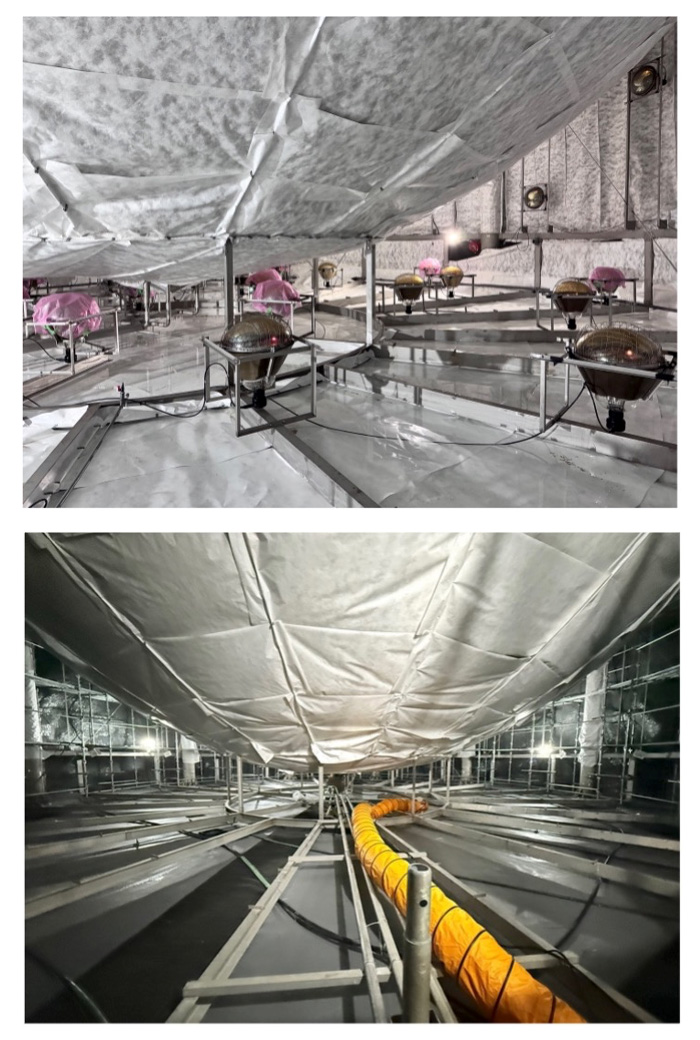
The outer detector consists of a water-filled tank (rock lined with a waterproof coating) and photosensors, serving three key roles: identifying cosmic-ray events, shielding against external background events, and cooling the inner detector. Prior to the refurbishment, KamLAND experienced increasing water leakage from the outer tank into the surrounding rock over the years, which reduced thermal stability in the inner detector and induced convection in the liquid within. As a result, issues arose such as the difficulty in correlating sequential events with relatively long intervals (several hours or more), and radioactive impurities originating from the surface of the liquid containment vessel (balloon) flowing into the center of the detector.
In this upgrade, a new topcoat of waterproof coating will be applied to the outer tank to address these issues. The photo above shows the outer tank prior to the refurbishment, equipped with photosensors and lined with white non-woven fabric to effectively diffuse light. The photo below shows the condition after removing the photosensors and non-woven fabric, followed by the application of the waterproof coating.